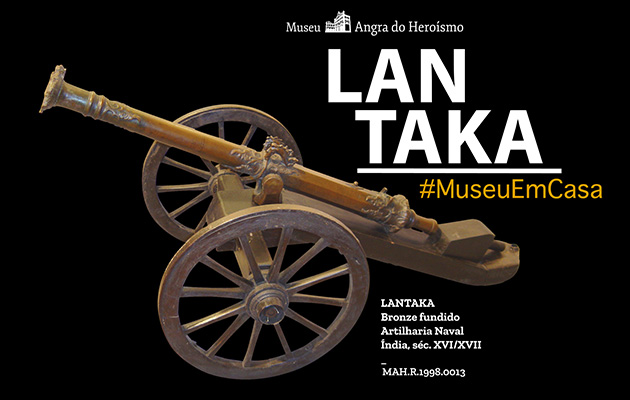
The “lantaka” is a small cannon, usually made of bronze, originating from Malaysia, an archipelago in Southeast Asia. Being a region of intense commercial activity with a significant flow of merchant vessels, the defense of these ships—especially against the numerous pirates—was essential. Thus, even before the arrival of the Portuguese in Southeast Asia, it was common practice for both merchants and pirates to use these small artillery pieces, typically mounted on bulwarks with forked supports.
When Afonso de Albuquerque besieged Malacca in 1511, he reported that his fleet was met with cannon fire. After the city’s fall, João de Barros mentions in his “Décadas” the capture of over 3,000 artillery pieces, 2,000 of them bronze, including naturally “lantakas” of various calibers. In letters sent to King Manuel I describing these exploits, Albuquerque noted that the captured artillery was of such quality “that it cannot be surpassed by Portuguese founders,” and he sent some examples back to Portugal.
Despite their high quality and characteristic design (about 1 meter long, calibers between 10 and 50 mm, a hollow trunnion for a wooden support, and a prominently decorated muzzle), early sixteenth-century lantakas were simply ornamented. Locally, beyond their military function, possessing a lantaka was also a sign of power and wealth. The Portuguese quickly recognized the importance of these artillery pieces for the locals, using them as currency in trade, as diplomatic gifts, and, for many merchants, as a means to ensure safe passage through pirate-infested waters.
In addition to locally produced lantakas, they were also cast in Portuguese foundries by Portuguese masters, notably in Goa, Macau, and in the Kingdom itself. As diplomatic or ceremonial gifts, their decoration became increasingly elaborate. They retained their Oriental aesthetic while incorporating new European decorative elements, including phytomorphic motifs and European interpretations of Malay fauna, as well as structural additions, such as dolphins near the trunnions, clearly visible on this example held by the Museu de Angra do Heroísmo.
After the fall of Malacca to the Dutch in 1641, the Dutch continued the diplomatic use of lantakas, relying on local foundries as well as foundries and master casters in other Dutch territories in the East Indies and the Netherlands. With the development of artillery, especially in the nineteenth century, lantakas became primarily symbolic objects of wealth, still fired today during the reception of important guests, weddings, and other significant social events. Their reduced military function led to a greater emphasis on decoration at the expense of the precision and quality of the barrel.
Despite their symbolic and social role, lantakas were returned to military use during the Philippine Revolution against Spanish rule (1896) and later during the Moro Rebellion (Philippines, 1899–1913), when they were used against American troops, cast at the time from church bells.
Thus, the lantaka represents a remarkable fusion of Eastern and Western cultures. From its original Malay identity, with a strong probable Chinese influence, it transformed from the sixteenth century onward into a distinct Luso-Malay identity that has endured to the present day.