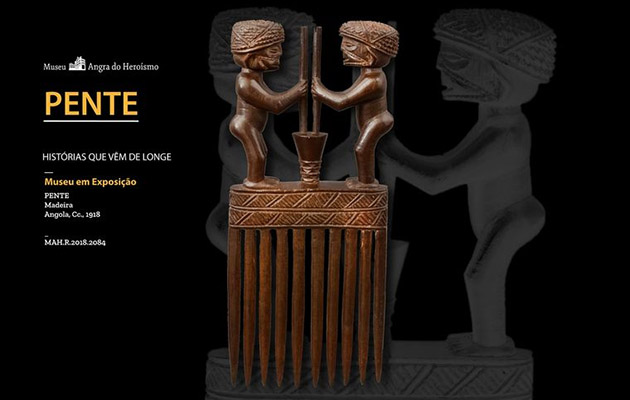
The comb is an everyday object whose name derives from the Latin word “pécten,” which refers to a marine mollusk with a shell featuring ridges similar to the teeth of a comb. It is believed that such shells were used to smooth hair before purpose-made combs were produced. The oldest known combs date back around 6,000 years and come from Egypt, often featuring handles decorated with animal and human figures.
This example, brought from Angola around 1918 by Joaquim Corte-Real e Amaral, an Azorean educator, politician, and intellectual, is currently part of the exhibition “Collections and Museums: From Curiosity to Knowledge,” on display in the Sala Dacosta until February 21. Combs like this one, carved from wood with depth and structure suited to the hand, are not only expressions of tribal status and affiliation but also manifestations of African aesthetics, whose influence is clearly visible in modernist avant-garde movements.
In Africa, hairstyles have long held strong symbolic significance, indicating, in certain communities, an individual’s ethnic identity, geographic origin, marital status, and social class. The iconic dimension of the comb is also reflected in the comb-fork with a handle shaped like a clenched fist and the peace symbol, created by Anthony Romani in 1972, proudly displayed in the hair or back pocket by activists of the Civil Rights Movement, which shaped societies across continents, especially in North America in the second half of the twentieth century.