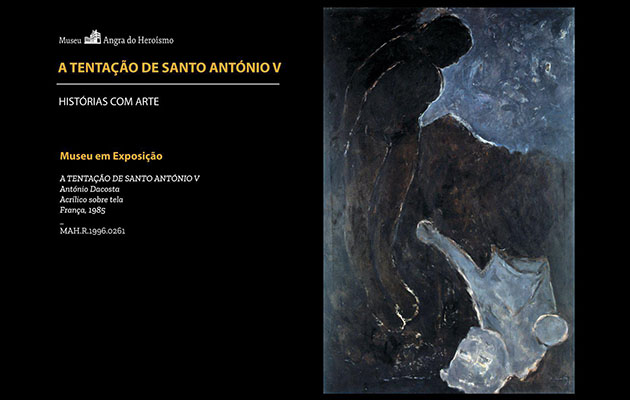
António Dacosta (1914–1990), a painter from Terceira, was one of the key figures responsible for breaking with traditional artistic language in twentieth-century Portugal. In the 1940s, he was a leading force in Portuguese Surrealism, and from the 1980s onwards he developed a painting style in which new figuration made him a landmark of contemporary Portuguese art at the end of the twentieth century.
Dacosta maintained a strong Azorean identity, particularly evident in his approach to the cult of the Holy Spirit. This large-scale work, forming part of the Fine Arts collection of the Museum of Angra do Heroísmo, also reflects this interest in religiosity. It was inspired by Grünewald’s altarpiece, painted between 1512 and 1516, which Dacosta admired during a visit to the Antonine monastery of Issenheim, near Colmar in Alsace, France. Created in 1985, it is part of a series of five paintings on the theme of the temptations of Saint Anthony, presented in 2010 in an exhibition at the Museum of Angra do Heroísmo.
According to the hagiography of Saint Anthony, this third-century Egyptian saint gives all his possessions to the poor and embarks on an introspective journey through the desert, living as a hermit in a cave. It is during this seclusion that, like Jesus, he is tempted by the Devil, who sends demons to torment him with all the pleasures of earthly life. The dark tones of the canvas evoke the cave, a lightless environment where evil prevails and salvation is absent, while the female figure personifies carnal desires.
Text | Inês Machado