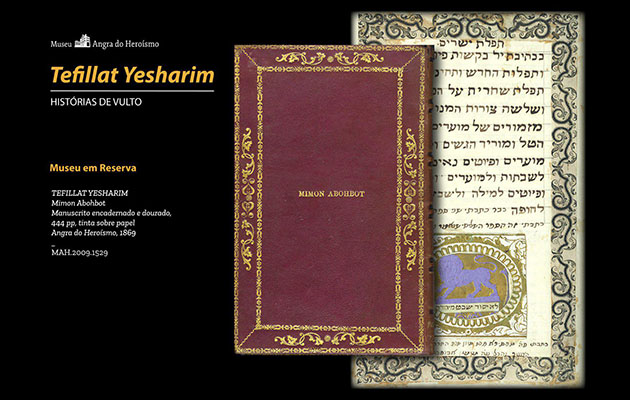
This Hebrew prayer book, authored by Mimom Abohbot, was written in Angra in the 19th century, documenting the return of Jewish families to the Azores for commercial reasons and their gradual social integration. Mimom Abohbot, of Moroccan origin, was an important merchant and a socially respected figure, not only among his fellow believers but also among the wider Angra community. In 1835, following the auction of nationalized properties from dissolved convents, he acquired, according to Pedro de Merelim in the work “Hebraicos na Ilha Terceira,” “the portion corresponding to the former Mosteiro da Esperança, on Rua da Sé, which he renovated and rebuilt,” establishing his residence there and founding a synagogue called “Tree of Life.”
“Tefillat Yesharim” means “The Prayer of the Righteous,” more precisely “The Prayer of Those Who Follow the Right Path.” The title originates from the Old Testament, Book of Proverbs 15:8: “The sacrifice of the wicked is an abomination to the Lord, but the prayer of the upright pleases Him.” The first Tefillat Yesharim appeared in 1740 in Amsterdam, created by Rabbi David Bem Raphael Meldola, who published a prayer book according to the Sephardic rite of the Portuguese-Jewish community there. He compiled all the prayers deemed necessary for a devout Jew to fulfill their religious duties and acts of devotion. Since then, the work has served as a model for many daily prayer books of the Sephardic rite worldwide.
This version, part of the Library and Documentation Center of the Museu de Angra do Heroísmo, includes original prayers by Mimom Abohbot and is one of only five known manuscripts authored by him. It can be viewed until February 21 in the Reserve of Animal-Drawn Transport, as part of the exhibition “Collections and Museums: From Curiosity to Knowledge.”
Text | Ana Almeida / Vítor do Castelo