“Indian” is a generic term referring to the native populations of the American continent, derived from the geographic mistake of Christopher Columbus, who, upon discovering the Bahamas in 1492, believed he had reached India. It is also commonly applied to the numerous ethnic groups inhabiting Brazil for millennia, long before its discovery by the Portuguese on April 22, 1500, whose idiosyncrasies remain largely unknown.
Pedro Vaz de Caminha, in his “Letter of the Discovery of Brazil,” was the first to express amazement at the natives of the then-called “Land of the True Cross”: “There you would see them graceful, painted in black and red, and quartered, both on their bodies and legs, which certainly looked well. Among them also walked four or five young women, so naked, that it did not appear improper (…) and with such innocence so uncovered, that there was no shamelessness in it.”
Almost simultaneously (1501-1506), Vasco Fernandes included in his “Adoration of the Magi” the first known depiction of an Amerindian in the West, portraying the Moorish king Balthazar as an Indian of the Tupinambá tribe crowned with feathers.
The “Miller Atlas” (1519), a compilation by cartographers Lopo Homem, Pedro Reinel, and Jorge Reinel, with illustrations by the miniaturist António de Holanda, already presents a map of “Terra Brasilis,” showing depictions of indigenous people adorned with colorful and feathered attire.
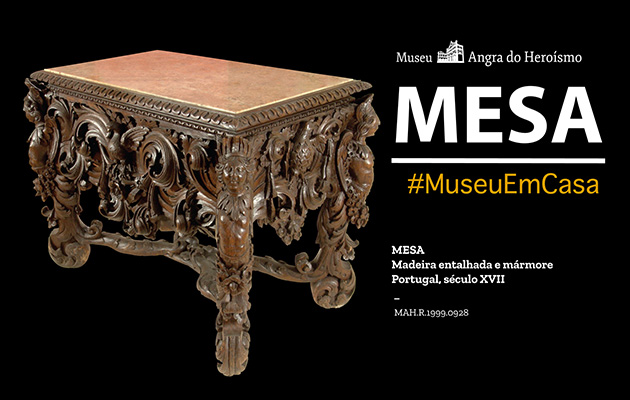
This fascination with difference and the exoticism of “Indian” adornments is also reflected in the splendid table highlighted here, on display in the exhibition “From Sea and Land… A History in the Atlantic.” The figures decorating it evoke a sculptural piece beloved by the people of Angra, the “preto” from Jardim Duque da Terceira, the former fence of the Convent of São Francisco, which, although exhibiting African phenotypical traits, wears a headdress and a loincloth, carrying a blowpipe—a hollow tube used by Amazonian peoples to hunt, enabling the user to blow a dart coated with curare, a compound obtained from boiling plants or animal secretions, which induces muscle paralysis.