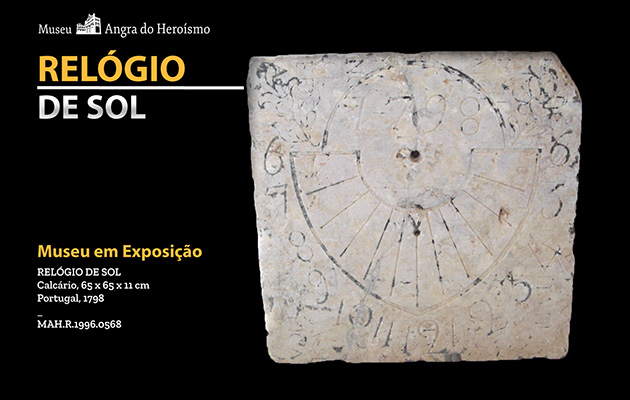
Until the 18th century, when large mechanical clocks gradually became more widespread, people regulated their lives by sundials, usually set into church façades. The shadow of a pin, inserted vertically into the stone, projected onto the illuminated dial, functioning as a hand; as the Sun’s position changed, the shadow moved across the surface, passing successively over the lines indicating the hours.
Although not highly accurate, sundials were prestigious objects, made from quality stone, as exemplified by this piece from mainland Portugal, executed on an old gravestone, from which some faded letters remain visible beneath the deep marks of its new use.
This sundial is part of the Stone Species Collection of the Museum of Angra do Heroismo and can be seen in the accessible reserve The Stones of Men, located in the narthex of the Church of Nossa Senhora da Guia, attached to the MAH.