The image of a woman spinning with a spindle in Ancient ceramics, or of a woman using the spinning wheel in medieval illuminations, besides its impact on the child’s imagination, helps us not only to chronologically situate these technological innovations but also to consider spinning as an important attribute of women of that time.
The first spinning tool—the spindle—is nothing more than a slender stick with a disc fitted at the lower end, which serves to accelerate the horizontal rotational movement transmitted to the fibers in an upward spiral motion, controlled by the spinner, producing the twist in the fibers, or more precisely, combining them into a thread as long and strong as possible.
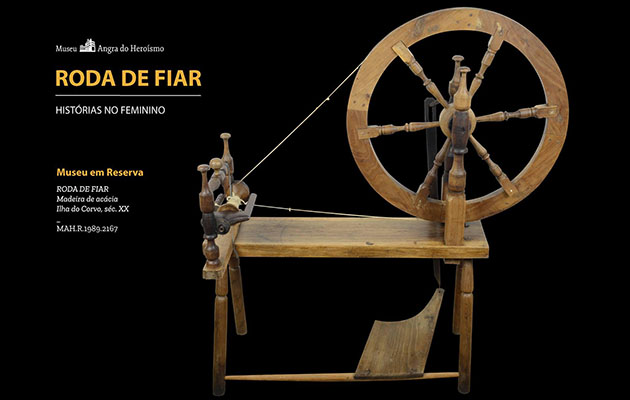
The spinning wheel, either hand-operated or foot-pedaled, increased thread production and is believed to have spread from the 14th century onward. In any case, this spinning device is essentially an innovation derived from the spindle, which is placed horizontally and connected to a driving wheel, increasing productivity and allowing the woman to spin while seated when using a foot pedal.
This piece belongs to the Ethnography Collection of the Museu de Angra do Heroísmo.
Text | Maria Helena Ormonde, ‘in’ “Instrumentos e trabalho e de Cultura”, MAH, 2017