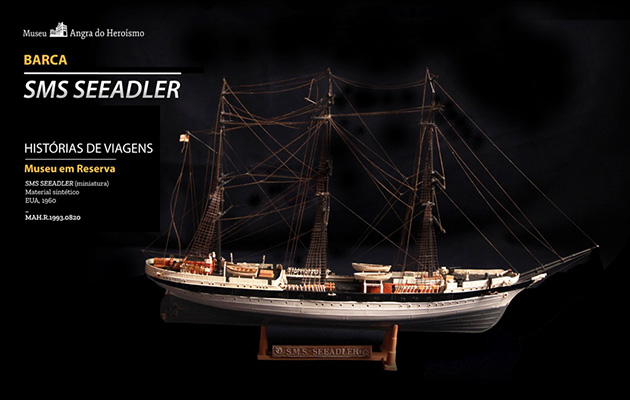
The SMS Seeadler (“Sea Eagle” in German) was a three-masted sailing ship. It was one of the last hybrid vessels used during the First World War (1914–1918), serving both as a merchant ship and a combat vessel for the Imperial German Navy.
Originally named Pass of Balmaha, it was built in Scotland in 1878. At the time, it was a steel-hulled ship of 1,571 tons and 245 feet in length, commissioned by a Boston-based company.
The vessel was captured by the German submarine SM U-36 in the North Sea under unusual circumstances. Forced to enter the German port of Cuxhaven, the American crew were granted safe passage to a neutral port due to their cooperation, but the ship became the property of the German Navy.
By 1916, German warships were blockaded by the Allies in the North Sea, and the few that managed to pass through could not refuel with coal. This led to the idea of using a sailing vessel, which did not require coal. Renamed Seeadler, the ship was then fitted with an auxiliary engine, hidden compartments, accommodations for extra crew and prisoners, two concealed 105 mm cannons, two heavy machine guns also hidden, and light weapons for boarding actions.
On 21 December 1916, the ship set sail under the command of Captain Felix von Luckner. Disguised as a Norwegian timber ship, it successfully evaded the English blockade despite being inspected. This was aided by selecting sailors who spoke Norwegian. Over 225 days, the vessel pursued and captured fifteen enemy ships across the Atlantic and Pacific, seldom using its weapons, causing only one fatality and sending the British and American ships on a merry chase.
The journey ended when the Seeadler ran aground on a reef on an island in French Polynesia. Luckner and some crew managed to sail to the Fiji Islands, where they were captured. The remaining crew seized a French schooner, the Lutèce, of 126 tons, on 5 September 1917. They renamed it Fortuna and sailed to Easter Island, arriving on 4 October. There, they ran aground again and were interned by the Chilean authorities.
This model is held in the reserve under the care of the Nautical and Aeronautical Collection of the Museum of Angra do Heroísmo.