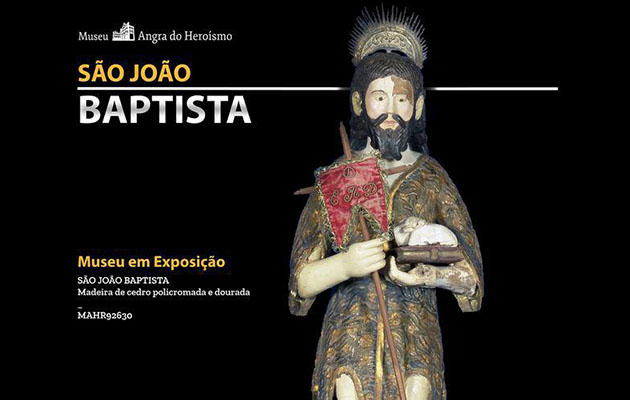
In 1642, after maintaining a siege that forced the Castilian forces confined in the then Castelo de S. Felipe to surrender, the people of Terceira Island, gathered at the Câmara de Angra, requested King D. João IV to rename the fortress from S. Felipe to S. João in honour of the newly acclaimed king and to authorise the construction of a church dedicated to St John the Baptist. The monarch granted the request, and by royal decree in 1643, authorised the building of the new church, granting the city of Angra the title of “sempre leal” (always loyal), along with other privileges and favours for its citizens. This image, belonging to the Fine Arts Management Unit of the Museum of Angra do Heroísmo, is thought to have been one of the first to occupy the main altar of the church then built, and it now forms part of the altar of the Chapel of Luiz Gonzaga in the Church of Nossa Senhora da Guia.
St John the Baptist is regarded as the first martyr of the Church and the last of the prophets. His prestige explains why his birth was aligned in the hagiological calendar with the ancient celebrations of the summer solstice and why he is highly venerated as a patron and protector. He earned his cognomen for baptising Christ, whose birth and sacrifice he foretold. Accordingly, he is depicted holding a staff in the shape of a cross and carrying the “Lamb of God who takes away the sins of the World.” His camel-skin garments, fastened with a leather strap—a nod to the camel’s hardy temperament and ability to endure long periods without water in the desert—symbolically refer to humanity’s resistance to accepting God’s word and their subjugation to sin.