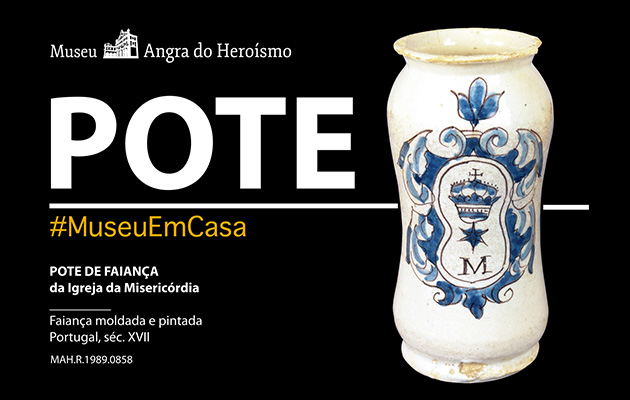
The pharmacy jars, or “mangas,” like this one, were used to store medicinal preparations or the ingredients employed to make them. In their decoration, they feature a Baroque panel painted in two shades of blue and maroon on a white enamel background, which encloses the coat of arms of the Order of Saint Philip Neri (Congregation of the Oratory), consisting of a six-pointed cartouche and the letter M topped with a closed crown.
With the Age of Discoveries, the circulation of new plants, as well as animal and mineral products from places such as India, Ceylon (present-day Sri Lanka), China, Africa, and Brazil, increased. Due to their properties, these products were exploited as therapeutic agents for a wide range of ailments. This includes tea, coffee, tobacco, cassava, pineapple, coca, ipecacuanha, aloe, turmeric, and cashew, not to mention spices such as pepper, nutmeg, and cinnamon, which could be used “per se” or incorporated into medicinal compounds.
The dissemination of these “drugs” owed much to the contributions of Portuguese scholars who recorded their research in botany and pharmacology, notably Tomás Pires, the first Portuguese ambassador at the Chinese court and author of Suma Oriental (1515), and Garcia da Horta, who settled as a physician in Goa and authored Colóquio dos Simples e Drogas e Cousas Medicinais da Índia (1563). Meanwhile, knowledge of the therapeutic applications of African and Brazilian flora was due to missionaries, settlers, soldiers, and travellers, although its inclusion in medical-pharmaceutical literature only occurred in the 18th century.
Medicine during the Age of Discoveries, based on Galenic Humoral Theory, generally resisted the novelties from Asia and Brazil, favouring bloodletting and purges in the treatment of various diseases and avoiding the use of new medicines and drugs.