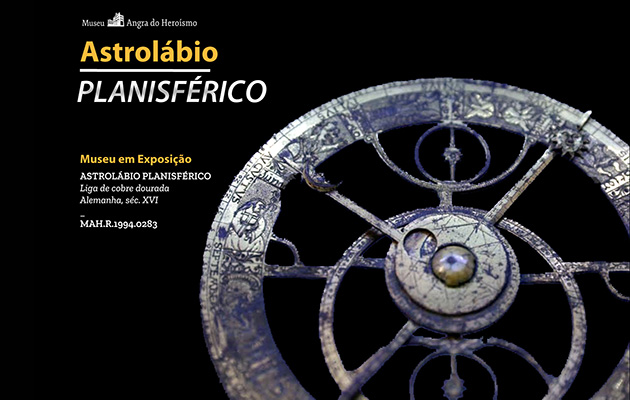
The planispheric astrolabe is believed to be a Greek invention, probably dating from the 9th century, which reached the Iberian Peninsula via Arab travellers. It was an astronomical observation instrument, allowing the identification of stars and the measurement of their altitude above the horizon, as well as the calculation of sunrise and sunset times. This made it particularly valuable in Islam, as it enabled not only the determination of the direction of Mecca but also the times for prayer.
The planispheric astrolabe consisted of a main circular piece, the mater, into which the tympans were inserted—small disc-shaped components bearing inscriptions showing spaced projections of a given number of azimuthal and altitude circles, which determined the local horizon’s altitude.
Fitting over the mater and tympans was a piece called the spider, which projected the celestial horizon as it appeared rotating around the North Pole, forming the centre of the astrolabe.
The spider bore the positions of the principal fixed stars, allowing the altitude and direction of a star to be read from the tympan. On the reverse of the mater, there was a solar calendar divided into 365 days, and a concentric circle divided according to the twelve zodiac signs and graduated in 360°.
Also on the back of the astrolabe was a movable pointer, the alidade, used primarily to read the altitude of celestial bodies by sighting along the graduated limb.
The planispheric astrolabe inspired the nautical astrolabe, refined by the Portuguese during the Age of Discoveries, who used it solely for measuring the altitude of stars, or as it was then termed, “weighing the sun.” It was adapted to their needs, being made in a copper alloy so that its weight made it less susceptible to the ship’s roll. The openwork design of the disc also reduced wind resistance at sea.
This object is part of the Nautical and Aeronautical Collection of the Museum of Angra do Heroismo, and is on display in the exhibition From Sea and Land… a History in the Atlantic.