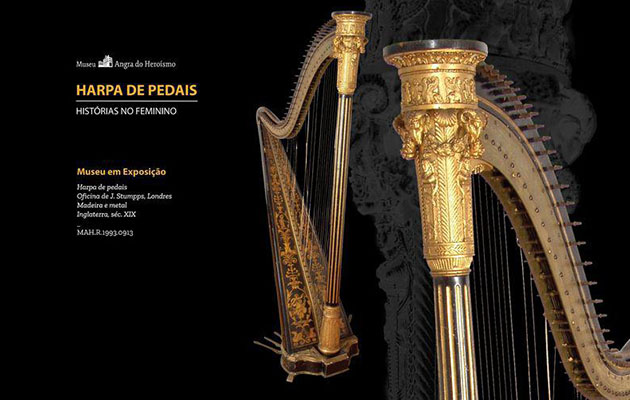
This pedal harp, decorated in the Pompeian style popular at the end of the 18th century, belonged to Cecília Borba, considered the finest harpist of her time.
Born in the parish of Sé on January 15, 1895, she was the daughter of Severiano Maria da Costa, a hardware merchant who owned a shop next to the former Armazém Severino. She grew up in an environment conducive to musical practice, as her mother, Maria Amélia Borba da Costa, was the sister of the Terceiran composer Pe. Tomás de Borba. However, her artistic career far surpassed her local and familial context.
During the 19th century and into the mid-20th century, musical education was considered an essential accomplishment for young ladies and women of the upper classes. However, music-making was generally confined to domestic entertainment. Cecília Borba distinguished herself through her remarkable artistic career, serving as a harp professor at the National Conservatory of Lisbon from 1920 and as a soloist with the National Symphony Orchestra for many years.
Cecília Borba’s harp, which now belongs to the Musical Instruments Collection of the Museu de Angra do Heroísmo and can be admired in the exhibition “Do Mar e da Terra… uma história no Atlântico,” was donated to the MAH by her sister, Carmelinda Borba Ferreira Marques, upon the harpist’s death in 1975.
Text | Ana Almeida