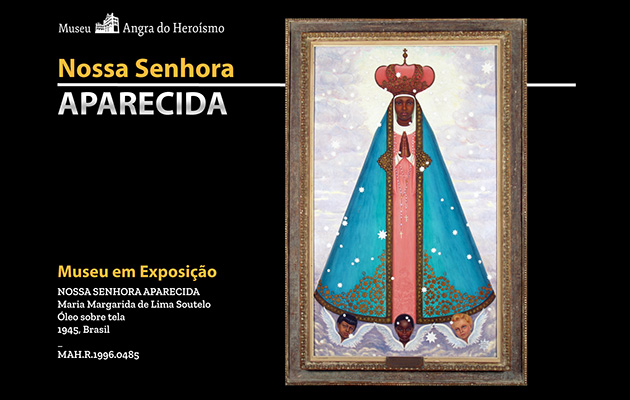
Marian devotion in Brazil finds its greatest expression in Nossa Senhora Aparecida, who is also represented in the country’s most significant iconography. Since 1980, following the visit of Pope John Paul II, her feast day, celebrated on 12 October, has been a national holiday in Brazil, over which she presides as patroness.
This artwork, depicting her supported by three angels—symbolising the three races that make up the Brazilian people—is by Maria Margarida de Lima Soutelo, a native of Terceira Island who emigrated to Brazil and became one of the leading painters of the twentieth century, widely known as the Azorean painter. The painting, which belongs to the Fine Arts Collection of the Museum of Angra do Heroísmo, was gifted by the artist through the Casa dos Açores in Rio de Janeiro, with Vitorino Nemésio acting as the intermediary.
According to legend, in 1717 three fishermen first caught the head, and then the body, of this terracotta image in their nets, whose usual polychrome finish had disappeared due to immersion in the waters of the Paraíba do Sul River. Once the two parts were reunited, fish—previously absent—were said to appear in such abundance that it was attributed to the intercession of Nossa Senhora Aparecida, whose dark complexion made her particularly revered by enslaved people and other marginalised communities.