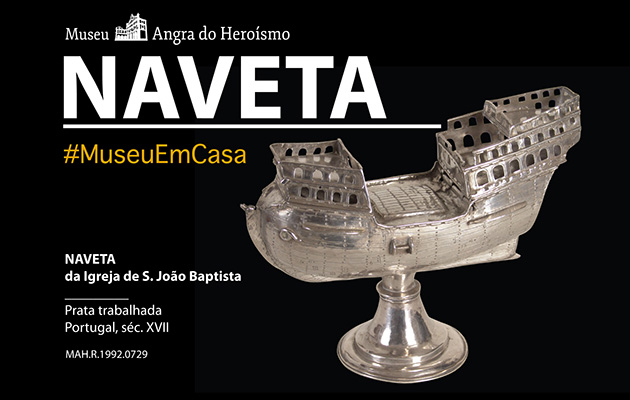
This navette, which belonged to the Church of the Castle of São João Baptista, is shaped like a Portuguese carrack, mounted on a circular base, with the connection between the foot and the vessel formed by a smooth conical section. The hull decoration reproduces, through engraved incisions, the planking and decking typical of real carracks, featuring pronounced forecastle and sterncastle, both adorned with balustrades decorated with pierced arcades.
Navettes, whose name derives from the Latin naviculla, a diminutive of navis (ship), are liturgical objects, usually made of silver, in which incense intended for burning in the thurible is stored, symbolising the ascent of the faithful’s prayers to heaven. They originate from the accerrae, small boxes used in ancient Rome to store fragrant resin burned during sacrifices. The liturgical ritual has incorporated incense burning since the early years of Christianity, and from the 9th century, the navette assumed the form from which it takes its name, although this has varied over time according to artistic styles and historical and social influences, such as those of the Age of Discoveries.
The abundance of silver on Terceira in the 17th century, explained by the stopovers of the Spanish Indies fleets on their return voyages to Europe, accounts for the large number of silversmiths and goldsmiths on the island; in 1620 there were around 132 residing in Angra. However, until the 18th century, Azorean silverwork bore neither stamps nor hallmarks, making dating, provenance, and identification difficult.
This piece is currently displayed in the second section of the exhibition From Sea and Land… a History in the Atlantic.