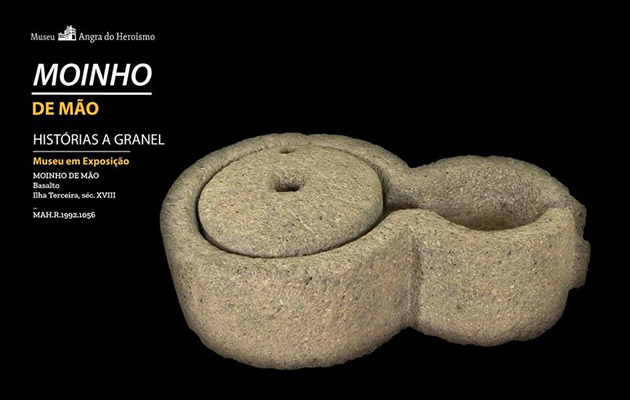
Azorean hand mills – considered among the most primitive – are composed of two pieces carved from basalt: a millstone with a central hole through which the cereal falls, and an eccentric handle to impart rotational movement, and a fixed base, which in this example has a high rim and a figure-eight shape.
These artifacts were essential domestic tools since the settlement of the islands, as they allowed the production of flour without the fees imposed by the millers under the captain-donatário system.
They persisted on these islands until very recent times, particularly on Terceira Island, where they were used to grind the carolo for preparing coarse porridge.
This piece can be viewed in the long-term exhibition at the Museum of Angra do Heroísmo, “Do Mar e da Terra… Uma História no Atlântico,” under the care of the Ethnography Collection.