In optical telegraphy, transmission is carried out using signals perceived by the human eye, through the observation of object positions (semaphores, flags, etc.) or natural (heliographs) or artificial light sources (signal lanterns).
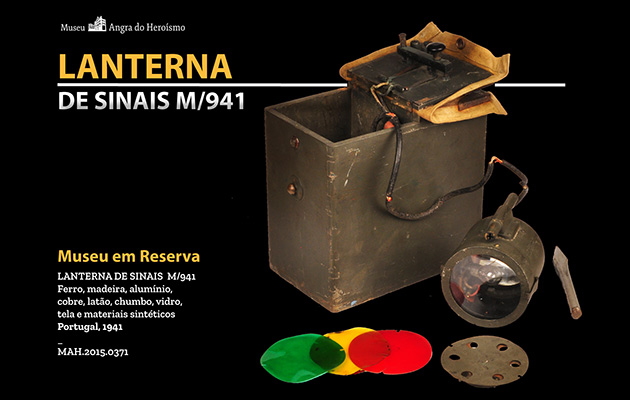
Although signal lanterns can be used during the day, they prove particularly useful for nighttime transmissions, as is the case with this lantern, part of the Military Collection of the Museum of Angra do Heroísmo, capable of transmitting light signals via a Morse key.
In the early 1940s, the General Engineering Workshops and later the Military Factory of Braço de Prata produced an evolved version of the British “Lucas” signal lantern, which had been used until then. It consisted of an aluminum body with a front glass, a lenticular mirror at the back, and a lamp. On top, it featured a tube for accurately aiming the lantern at the receiver, and it could be mounted on a metal stake or a heliograph tripod. It allowed a visual range of 8 km at night and about 4 km during the day, depending on weather conditions.
The lantern was stored and transported in a wooden box with two compartments. One compartment, in addition to the lantern, held three celluloid discs (red, green, and yellow) and a shutter disc to reduce light intensity. The other compartment housed a 12-volt battery and a spare parts box. The Morse key was fixed to the underside of the lid, covered with Mills canvas protecting the lantern compartment.