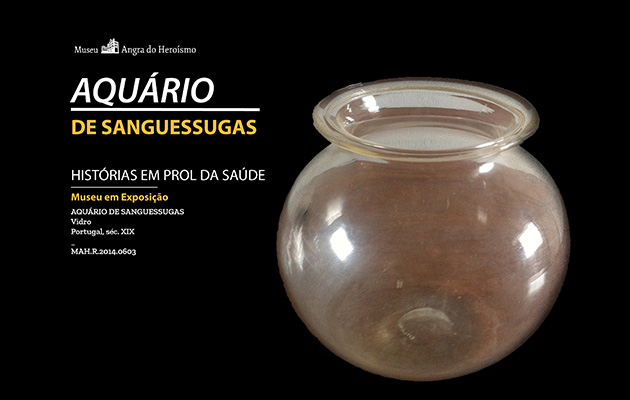
The leech is an invertebrate animal, worm-like in appearance, belonging to the annelid family, with around 600 species known. The most common is the medicinal leech, Hirudo medicinalis, which is aquatic and therefore kept in aquariums such as the one displayed here.
Typically dark in colour and measuring around 5 to 12 millimetres, leeches have two suckers: a small one at the front and a larger one at the rear. They have been used in medicine for thousands of years, but their use became widespread in the Middle Ages due to the adoption of Galenic humoral theory, which associated health with the balance of four humours—blood, phlegm, black bile, and yellow bile. In the case of illness, the first, considered the dominant humour, was to be removed either through bloodletting or by applying leeches, a task carried out by barbers responsible for medical practices involving the shedding of blood.
The leech draws blood from its host by biting the skin and attaching a sucker to the wound. Once fixed, it secretes an anticoagulant enzyme (hirudin) into the bloodstream, preventing clotting. The blood is stored in a pouch within the leech’s digestive system, where it can be kept for several months.
An article in issue no. 89 of the periodical Íris, published in 1839, reports that leeches were sold for 100 to 120 réis at the Pharmacy of the Hospital of Santo Espírito de Angra. More recently, leeches have been used post-operatively for patients who have had limbs reimplanted and in plastic surgery, as their blood-sucking stimulates the formation of new veins, which are difficult to reconnect surgically. They are also employed in the treatment of oedemas, ulcers, varicose veins, and in reducing arthritis pain. The therapeutic value of leeches lies not in the blood they consume but in the anticoagulant and vasodilator they secrete, which keeps blood flowing for up to ten hours after removal from the patient, preventing its accumulation in tissues.
This object is part of the Science and Technology Collection of the Museum of Angra do Heroismo.