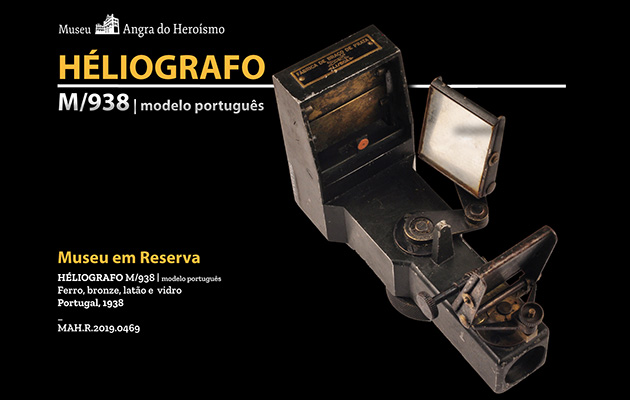
Conceptually, a heliograph or optical telegraph uses the reflection of sunlight in a mirror to communicate between two points in line of sight, usually employing Morse code.
This model was developed in Portugal and produced from 1938, first at the General Engineering Workshops and later at the Military Factory of Braço de Prata. It is portable and can communicate over several kilometers, depending on visibility and sunlight intensity. Using a system of manually operated metal shutters, the sunlight reflection can be exposed or concealed, allowing messages to be transmitted in Morse code.
In Portugal, heliographs have been used for military communications since the 19th century. By 1899, there was a national network of fixed heliographs (which could be supplemented by portable units) covering up to two-thirds of continental Portugal. This device is part of the Military Collection of the Museum of Angra do Heroísmo.