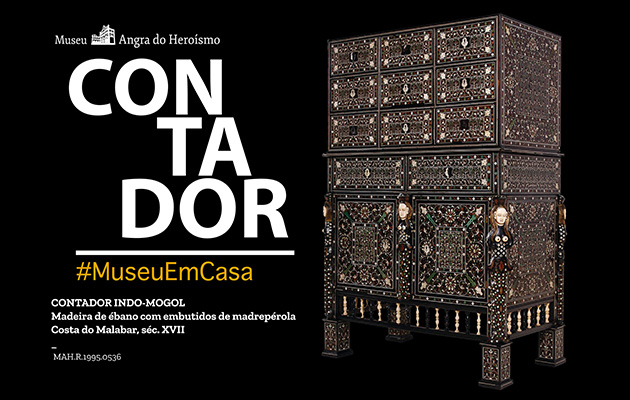
It can be said that the Age of Discoveries marked the beginning of globalization, and the beauty that arises from the combination of experiences and knowledge from different civilizations is clearly visible in pieces such as the cabinet we highlight today.
The cabinet is an essentially seventeenth-century piece, used to store documents and valuables, whose artistic quality reflected the social status of its owner. It derives from the sixteenth-century writing desk but differs from it by featuring drawers with visible locks, rather than being covered by a top that, in the earlier model, served as a writing surface.
This magnificent example, part of the Collection of Decorative and Ornamental Arts / Furniture at the Museu de Angra do Heroísmo, is inspired by Portuguese prototypes taken to Goa and copied there, while its decoration and technique align with Mughal production.
The piece consists of two sections: the cabinet itself and the supporting case. The drawers arranged across the front create the illusion that they are all the same size, though this is not the case.
“Moghul” or “Mughal” refers to the dynasty founded by Babur, a warlord from Central Asia, who, by conquering the Sultanate of Delhi in 1526, established a Muslim empire in India that lasted over three centuries. Among the Mughal emperors, Jalal-ud-din Muhammad Akbar (1556–1605), also known as Akbar the Great, stands out. He strengthened his position in northern India, ensured economic stability, and gathered the empire’s top artists in the imperial workshops, producing works that reflected diverse sources of inspiration. To this, the influence of Portuguese missionaries was added. The fusion of all these contributions resulted in an artistic expression with its own distinct, refined, and meticulous identity, as exemplified in this splendid cabinet.