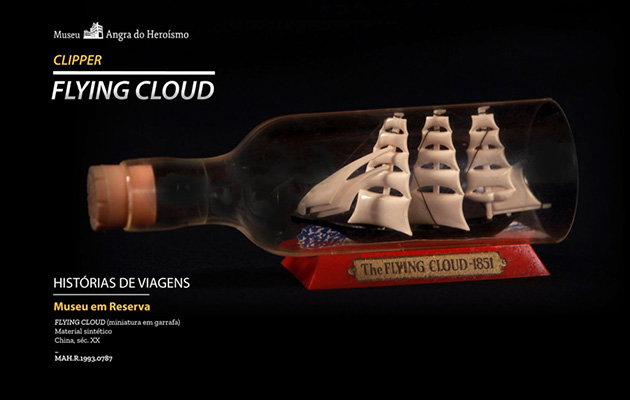
The Flying Cloud, launched in 1854, was the most famous of the “extreme clipper” ships built by Donald McKay in Boston, commissioned by Enoch Train. Six weeks after its launch, the vessel sailed from New York to San Francisco, via Cape Horn, in 89 days and 21 hours under the command of Captain Josiah Perkins Cressy. On 31 July, during the voyage, the ship covered 374 nautical miles in three days. In 1843, it broke its own record by 13 hours, a benchmark that remained unbeaten until 1989, when a purpose-built sailing vessel, Thursday Child, completed the passage in 80 days and 20 hours.
During the early days of the California Gold Rush, it typically took more than 200 days for a ship to travel from New York to San Francisco, a journey of over 16,000 miles. The Flying Cloud, by cutting this time nearly in half (to just 89 days), established a world reference record, which it would surpass itself three years later, creating a new record that stood for 136 years.
The achievement of the Flying Cloud was remarkable in any context, but even more extraordinary because its navigator was a woman. Eleanor Cressy, wife of the ship’s captain, had studied ocean currents, meteorological phenomena, and astronomy since childhood and, alongside her husband, logged thousands of miles across the oceans, circumnavigating the globe while transporting passengers and goods. Following the establishment of their New York–California record, Eleanor and Josiah became instant celebrities. However, their fame was short-lived and the story quickly faded. Josiah died in 1871, and Eleanor lived away from the sea until her death in 1900.
In 1862, the Flying Cloud was sold to sail under the British flag, keeping its name, and soon operated between the United Kingdom, Australia, and New Zealand. Its final years were spent transporting timber between Britain and St. John, Canada. On 19 June 1874, the Flying Cloud ran aground on the Beacon Island bar in Newfoundland. It was irrecoverable and sold. A year later, it was burned to recover its metal and copper rigging.
This model is held in the reserve under the care of the Nautical and Aeronautical Collection of the Museum of Angra do Heroismo.