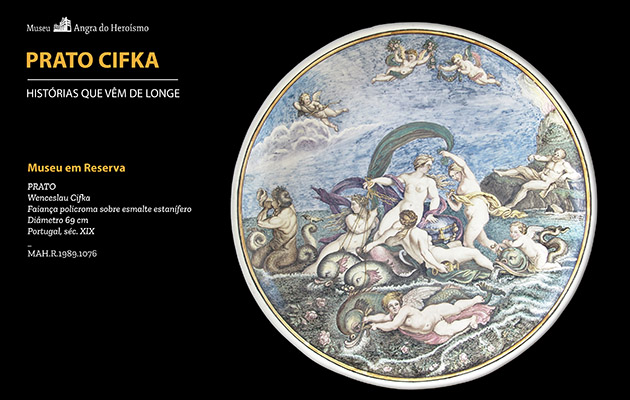
In mid-19th century Portugal, there was a noticeable shift in taste for ceramics. With the arrival of D. Fernando II, the German prince who married Queen D. Maria II, ceramic production gained new impetus, although initially it remained confined to a small circle of the court aristocracy. Among the notable figures in this circle, which included the king himself, stood out Wenceslau Cifka, a prolific artist whose erudite production incorporated elements from his collection of old engravings, and whose palette evoked porcelain. Many of these pieces were made at the factory installed in the former Convent of Nossa Senhora dos Remédios, at Janelas Verdes in Lisbon, known by that name from 1836 to 1842, until it was renamed Fábrica Constância under a new owner.
From this period comes the large plate “Galatea,” part of the Decorative Arts Collection of the Museu de Angra do Heroísmo, featuring a decorative composition inspired by classical themes that demonstrates the artist’s mastery in representing the female nude. In Greek mythology, Galatea was a nereid, daughter of the sea deities Nereus and Doris, who traversed the seas of Sicily in a chariot drawn by dolphins. Her beauty aroused the passion of the cyclops Polyphemus, who, enraged by jealousy, crushed her lover Acis with a rock. Galatea revived her beloved, transforming him into a river, and threw herself into the waves of the sea, so that their union might become eternal.
Source cited | “European Ceramics from the 17th to 19th Centuries,” Alexandre Pais, Museu de Angra do Heroísmo, 2010
Text: Ana Almeida