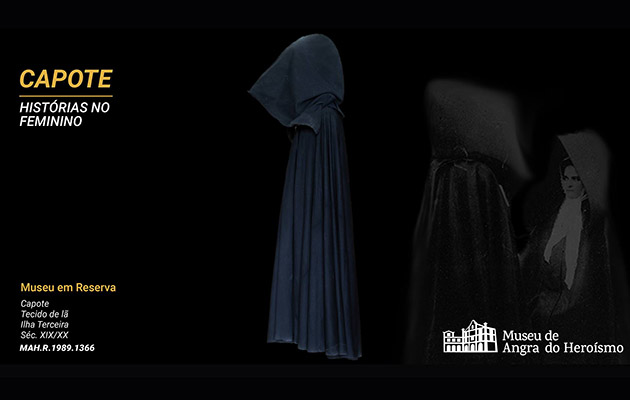
The coat and hood ensemble was the characteristic attire of Azorean women and formed part of the social and cultural identity of the Azores, as Raúl Brandão notes in As Ilhas Desconhecidas published in 1926: “What gives this land its great character is the coat. One walks through the deserted streets and, from time to time, a black and shapeless ghost bursts out of a door, with a large hood over its head (…). I begin to take interest in this fantastic blackness and decide that it should be the only garment allowed for Azorean women.”
The coat is a full, circular cloak made of thick, durable English cloth, in dark blue or black, that covered a woman’s body down to her feet. The hood is a head covering supported by a metal or whalebone frame, usually lined with hemp to maintain its shape and rigidity. This ensemble often formed part of a woman’s dowry and was passed down through generations, frequently serving all the women of a household. Its design varied from island to island.
Its exact origin remains unknown. Some suggest the coat was imported from Flanders, while others see it as an adaptation of the cloaks and hoods that were fashionable in Portugal during the 17th and 18th centuries.
Text | Cátia Sousa