Barbie, probably the most famous doll of all time, was created in 1959 by Ruth Handler, who, together with her husband Eliot Handler and their friend Harold Matson, founded in 1945 in California what is today the world’s largest toy manufacturer, Mattel.
Her slender and sensual figure contrasted with the infantilised dolls of the time, reflecting the refined glamour of 1950s film stars such as Marilyn Monroe, Rita Hayworth, and Elizabeth Taylor. The elegant First Lady, Jackie Kennedy, also inspired the first models, both in terms of clothing and hairstyle. Subsequent versions introduced new hair colours, eye colours, and make-up, incorporating new techniques and materials that reflect the evolution of the toy industry, such as open-and-close eyes, bendable legs, and the use of elastomer, which makes the doll both durable and flexible.
Social and cultural changes also shaped Barbie’s history. In 1968, Christie, Barbie’s Black friend with African features, was introduced, in contrast to Misty (1965) and Colored Francie (1967), both with dark hair but Caucasian features. In 1963, following the excitement of the space race, a Barbie inspired by the Russian astronaut Valentina Tereshkova was released, conveying the message that all careers were accessible to girls. A very different message led to the withdrawal in 1992 of a blonde Barbie, equipped with a mechanism that, when pressed, gave a message implying that learning mathematics was difficult—this model was strongly criticised by feminists.
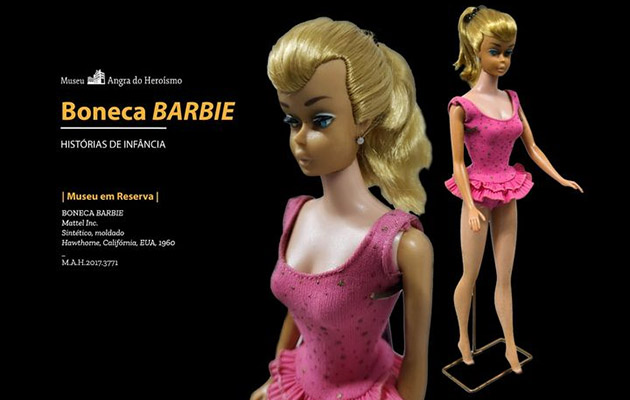
The Barbie presented here, produced in 1960, forms part of the Toys and Games Collection of the Museum of Angra do Heroísmo and was donated in 2017 by Maria de Jesus Toste.