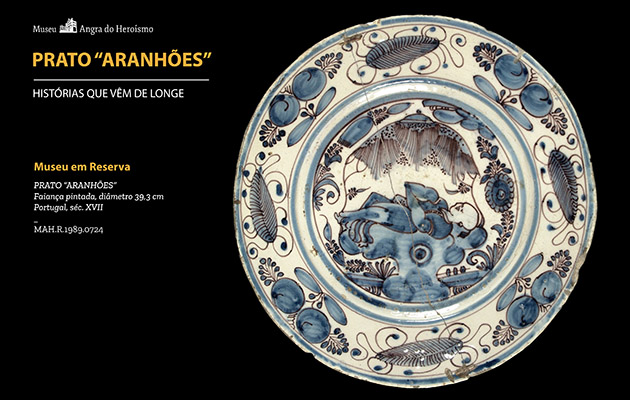
With the Portuguese Discoveries, pieces of Chinese ceramics began arriving in Europe in large quantities, influencing Portuguese faience, which in the 17th century developed its own decorative characteristics. According to José Meco, these derived “from the intensive use of Chinese figures, motifs, and symbols, and the preferential adoption of cobalt blue painting on a white tin glaze.”
This influence of Chinese porcelain is clearly seen in the highlighted plate, whose center depicts a monk lying on a rock, his body shaded by a large parasol with undulating fringes. The decoration on the rim is also inspired by Ming porcelain, forming what are commonly called “aranhões,” in this case loosely interpreted representations of artemisia leaves, alternating with branches and peach fruits, which in China were considered auspicious, symbols of marriage, immortality, and spring.
Sources cited | “Porcelanas” de Lisboa | The Charm of 17th-Century Portuguese Faience,
José Meco, in “Lisboa na Origem da Chinoiserie | 17th-Century Portuguese Faience, Mário Roque Collection,” São Roque | Antiguidades Galeria, n.d.
Text: Ana Almeida