When, in 1543, the winds drove a Chinese junk—carrying the Portuguese Fernão Mendes Pinto, António Peixoto, and Diogo Zeimoto—to the Nippon coast, Japan was a feudal system (shogunate) with constant wars between feudal lords or between islands. Despite this ongoing state of conflict, which prompted extensive philosophical, ethical, and tactical reflections on the Art of War, gunpowder and firearms were unknown.
When Diogo Zeimoto, using his matchlock musket, killed 26 ducks near a marsh, the astonishment was so great that Nautaquim, the prince of Tanegashima Island, came to see for himself. Zeimoto then killed an additional thousand birds and three doves. In recognition of this remarkable demonstration, Nautaquim was honored by Zeimoto, who gave him the musket and taught him how to make gunpowder.
Equally astonishing, as recounted by Fernão Mendes Pinto in Peregrinação, was that about five and a half months later, there were already more than 600 muskets of this type, and by 1556, over 30,000. The introduction of firearms had a profound impact on Japan, affecting both warfare and social organization, as Japanese historians unanimously note. Most notably, it facilitated the unification of Japan under Oda Nobunaga, a major territorial lord and military leader in the latter half of the 16th century, whose soldiers were armed with muskets.
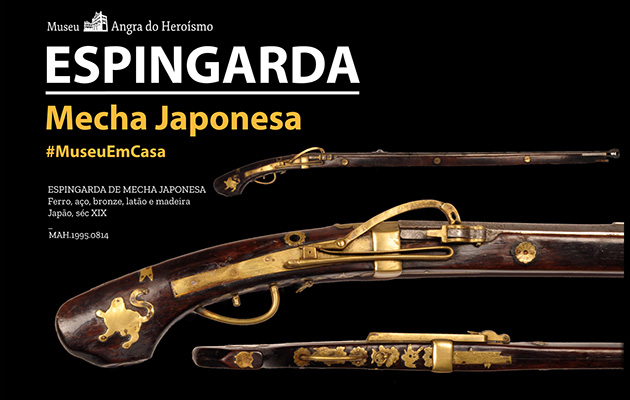
The firearm Zeimoto introduced to Japan was a Bohemian-style matchlock musket from the late 15th to early 16th century. Its mechanism involved a serpentine carrying the lit match, which moved back and forth, manually cocked, and then dropped onto the powder via a trigger (Schnapp-Lunt). This differed entirely from Asian matchlocks or those from Nuremberg and Augsburg, where the cock moved continuously toward the powder via a lever.
Due to Japan’s cultural isolation and geographic distance, this mechanism crystallized into the Japanese matchlock, remaining in use until the 19th century. The style and decorations also became distinct, giving these firearms a unique identity.
Every July, on Tanegashima Island—where the Portuguese first landed with their matchlock musket and after which the firearm type is named—the Teppo Matsuri festival is held. This major celebration features hundreds of matchlocks, both originals and replicas, firing and reenacting battles of the 16th century.
This example at the Museu de Angra do Heroísmo, with the characteristic shape, standard mechanisms, brass fittings, and modest floral decoration, is datable to the second half of the 19th century.