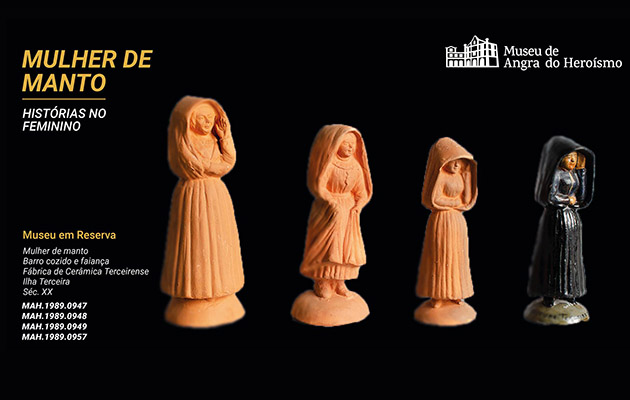
Within what is known as Regional Ceramics, there is a notable group of earthenware or faience pieces characterized by regionalist motifs, which serve as unique documents of the construction of a regionalist imagination, through the typification of the basket man, the milkman, or, as in the case of the examples highlighted here, the woman in cloak.
These different representations of the most emblematic of the traditional female customs of Terceira belong to the Collection of Decorative and Ornamental Arts of the MAH and were produced by the Fábrica de Cerâmica Terceirense, commonly known as Fábrica Scotto, originally established as the Fábrica de Louças Progresso Terceirense in 1886 by Jacinto Martins Cardoso and Zeferino Augusto da Costa.
Although seemingly identical, each figure presents small variations, both in the woman’s features and in the different degrees of formality in the attire. Notice the expressiveness of the first figure’s face, with a carefully modeled hand slightly lifting the cloak from the face, almost completely veiled in the last two examples. The second figure, smiling and playful, holds the cloak casually, revealing details of the dress and displaying a relaxed posture that contrasts with the stillness of the others.
Pieces like these reflect the effort of a group of Terceirenses in the 1930s and 1940s to invest in the local economy, seeking to create new products for local consumption or to supply a tourist market that already existed or was imagined.
Text | Ana Almeida | Helena Ormonde