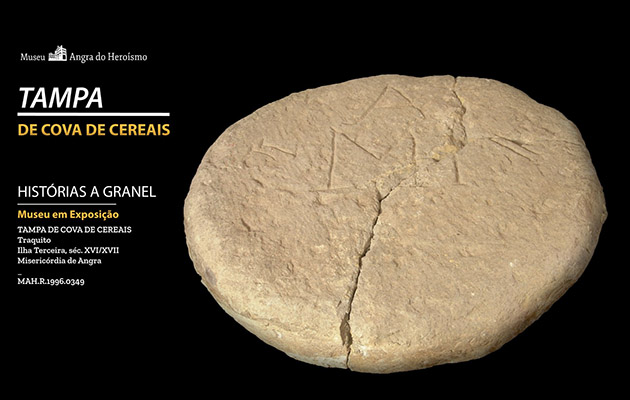
This stone, dome-shaped and engraved with an “M” on its flat surface, was recovered from the subsoil of Alto das Covas, in Angra do Heroísmo, in the 1950s. It served as a cover for one of the silos or pits used for storing cereals (wheat) at this site, probably dating back to the 16th century. These pits were commonly used by convents and similar institutions. In this case, the stone likely belonged to one of the silos of the Misericórdia of Angra.
“In this city and throughout the island of Terceira, residents customarily, in the summer, when harvesting wheat, store it in pits dug into the ground, shaped like barrels […] and they say that wheat stored this way makes much better bread and yields more, remaining in the pits for three, four, or six months, or even a whole year, without suffering any significant deterioration.”
Gaspar Frutuoso, ‘Saudades da Terra’, 1586-1590
This piece is part of the Stone Species Management Unit of the Museum of Angra do Heroísmo and is on display in the long-term exhibition, “Of the Sea and the Land… A History in the Atlantic.”