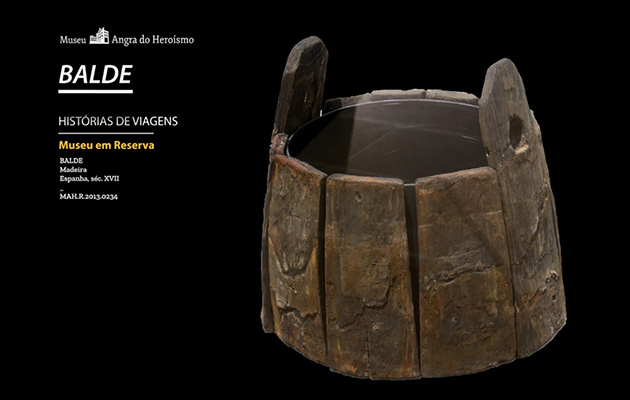
This wooden bucket was recovered during an underwater archaeological survey carried out in 1996 in the Bay of Angra do Heroísmo. Inside it, fish bones were also found, confirming that whenever conditions allowed, the otherwise limited shipboard diet was supplemented with fresh fish.
The vessel from which it originated, named Angra D, lies at a depth of 6.5 metres, well preserved under a thick layer of stones from the ballast and sandy sediment. Oriented east-west, parallel to the coastline, its length was estimated at 35 metres, with a maximum width of 10 metres and a minimum of 7 metres.
The majority of the ceramics recovered, indicative of early 17th-century Hispanic material culture, along with traces of mercury originating from Spain and intended for mines in the Americas, led to the conclusion that the vessel dated from the 17th century and was of Iberian origin, most likely Spanish.
The vessel was dismantled and moved to a location within the same bay but out of the reach of construction works for the Marina of Angra do Heroísmo, becoming part of the Subaquatic Archaeological Park of Angra do Heroísmo.
This piece is part of the Archaeology Collection of the Museum of Angra do Heroísmo.