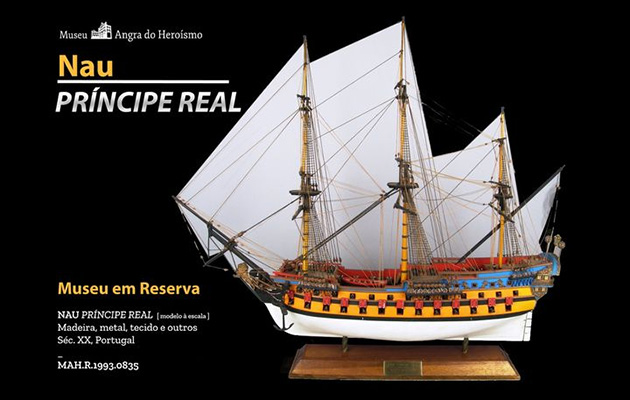
The Príncipe Real was a ship of the line in service with the Portuguese Navy between 1771 and 1822 and was the most powerful Portuguese warship ever built. The vessel was constructed in 1771 at the Royal Navy Arsenal in Lisbon under the direction of Manuel Vicente Nunes and was originally christened Nossa Senhora da Conceição. Officially classified as an “80-gun ship,” it could actually carry up to 110 cannons. During its early career, Nossa Senhora da Conceição served as the flagship of the Strait Squadron, under Lieutenant-General José Sanches de Brito, ensuring the safety of navigation through the Strait of Gibraltar. In 1794, the ship was overhauled and renamed Príncipe Real. The new name followed the Portuguese Navy’s policy of naming ships after historical, mythological, or royal figures, instead of saints, as had previously been customary. The Príncipe Real joined the Portuguese squadron sent to the Mediterranean in 1788 to assist Admiral Nelson’s British naval forces. Until 1800, it remained in the Mediterranean as the flagship of the admiral, the Marquis of Nisa. In 1807, the Príncipe Real sailed to Brazil as the flagship of the squadron transporting the Portuguese Court. Commanded by Captain of Sea and War Francisco José de Canto e Castro Mascarenhas, on board were the fleet commander-in-chief, Squadron Chief Manuel da Cunha Sotto-Maior, and the Prince Regent, D. João. At the time of Brazil’s independence in 1822, the Príncipe Real was anchored in the port of Rio de Janeiro. It was then incorporated into the new Brazilian Navy as part of its initial core of ships. However, as it was no longer seaworthy, it was converted into a depot ship. This model belongs to the Nautical and Aeronautical Collection of the Museum of Angra do Heroismo.