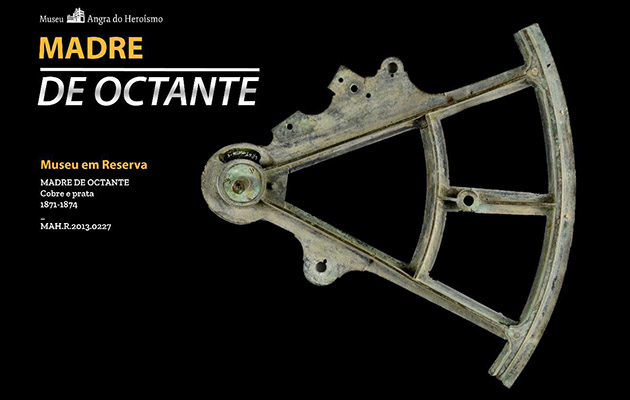
The octant is a double-reflection navigation instrument invented by Thomas Godfrey and John Hadley in the early 1730s. This device allowed readings of altitudes up to 90°, a capability that made it a highly useful tool for astronomical navigation at sea. Its compact design and the use of mirrors increased the accuracy of latitude measurements.
The inscription on this base, “Crichton Bros. London, Made for J. Warden Liverpool”, helps reconstruct part of its history. The Crichton Brothers worked between 1871 and 1877 at 11 Biliter Street, London, as manufacturers of mathematical, optical, and nautical instruments, supplying other vendors of such products, such as John Warden, established at 2 Canning Place, Liverpool, between 1864 and 1874, who, although also producing precision instruments, did not manufacture nautical devices.
The octant is a double-reflection navigation instrument invented by Thomas Godfrey and John Hadley in the early 1730s. This device allowed readings of altitudes up to 90°, a capability that made it a highly useful tool for astronomical navigation at sea. Its compact design and the use of mirrors increased the accuracy of latitude measurements.
The inscription on this base, “Crichton Bros. London, Made for J. Warden Liverpool”, helps reconstruct part of its history. The Crichton Brothers worked between 1871 and 1877 at 11 Biliter Street, London, as manufacturers of mathematical, optical, and nautical instruments, supplying other vendors of such products, such as John Warden, established at 2 Canning Place, Liverpool, between 1864 and 1874, who, although also producing precision instruments, did not manufacture nautical devices.
This object was incorporated into the Archaeology Collection of the Museum of Angra do Heroismo, following a chance discovery in Fanal Bay.
_
In the catalogue Stories from the Sea | 2013 [adapted]