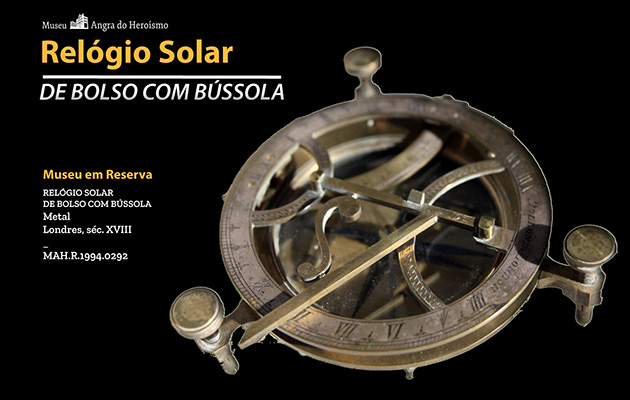
In the past, of all mathematical instruments, the sundial was perhaps the most common. The main reason for this was that any mechanical clock required a sundial to verify that it kept the correct time.
It is believed that in the 17th and 18th centuries, the number of sundials equalled the number of clocks in use. Later, it became more practical to maintain exact local time, for example on railways, through the electric telegraph, which appeared in 1837. In a short time, the National Telegraph Company in the United Kingdom had clocks showing Greenwich Mean Time in its offices everywhere, and from then on, sundials lost their practical importance and became primarily decorative objects.
A sundial identical to this one, dated 1790, was used by the renowned English naval surgeon and explorer George Bass during the first European exploration of the southern Australian coast, in a small anonymous whaleboat, between December 1797 and February 1798. The voyage of over 3,000 km in a small open boat brought considerable credit at the time to Bass’s skills in seamanship and navigation, providing evidence that Tasmania was an island, separate from the mainland.
_
In Cabinet of Curiosities/1