The projectiles of the earliest pyrotechnic weapons (artillery) were likely made of stone, and the cannons were known as “pedreiros” or “de roca,” depending on whether they fired a single stone shot or a bag of smaller stones.
With the development of iron shot, stone projectiles (and the rocas) continued to be used, particularly in large-calibre guns, as they were more effective for breaching walls during siege operations.
Stone shots, made from material with a density similar to that of the walls, were far more effective—provided they were fired at low velocity to avoid shattering on impact—than iron shots, which often became embedded in the walls and contributed little to their collapse.
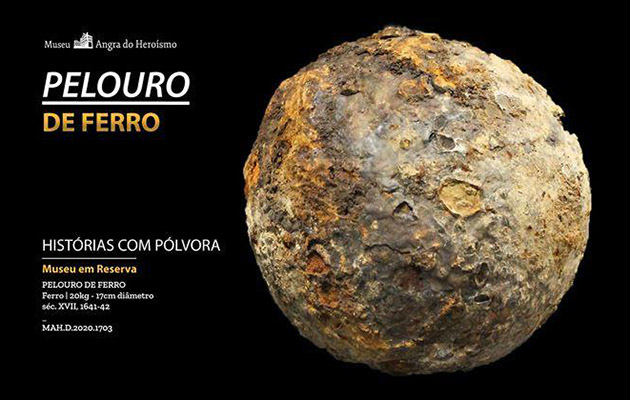
Measuring 16 centimetres in diameter and weighing around 20 kilograms, this iron shot, part of the Archaeology Collection of the Museum of Angra do Heroismo, was discovered by chance at the top of Rua Conselheiro José Silvestre Ribeiro (near the former Casa da Roda) during electrical cabling works, at a depth of one metre. Its location places it within a turbulent and decisive period in the history of Angra: the early siege of the then Fortress of São Filipe between 1641 and 1642, following the Restoration of Portugal’s Independence, when it was fired to deter the besiegers.