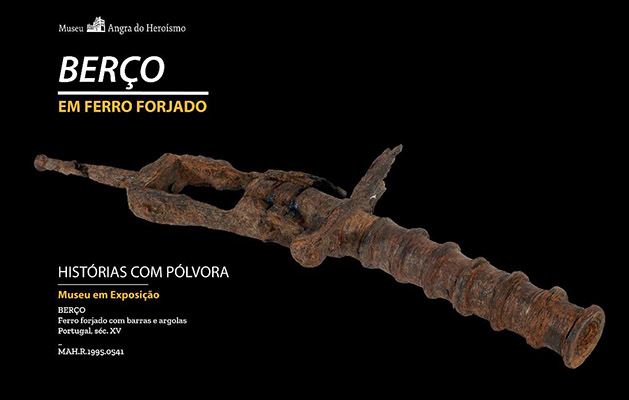
The earliest artillery pieces were made of wrought iron, constructed by joining longitudinal iron bars, reinforced by transverse iron hoops, placed closer or further apart depending on the required strength.
In response to threats from Maghreb and Northern European pirates to Portuguese trade routes and coastal settlements, it became necessary, from the earliest days of artillery, to arm some small caravels (around 80 to 100 tons) known as “escort” ships with firearms.
Due to the limited space on board and the difficulties associated with muzzle-loading these guns, breech-loading pieces were preferred. The gun carriages, small-calibre firearms (7 to 10 cm), mounted on a pivot (fork) on the ship’s bulwarks, allowed easy aiming, independent of the ship’s manoeuvres. Breech-loading with pre-charged powder chambers ensured a high rate of fire that more than compensated for their small calibre.
This object is part of the Militaria and Weaponry Collection and is on display in the long-term exhibition From Sea and Land… a History in the Atlantic.